Feeling strong in your body starts with being connected to your center, also known as your core. If you’ve had a child within the last decade, you may still feel disconnected to your center. Pregnancy understandably does a number on your core: your abdominal muscles get stretched to their limits, your internal organs get pushed aside to make way for a growing human, and your back bears the load of many extra pounds. All of that without even beginning the conversation around your pelvic floor, hips, and ribs.
Returning to a connection with your core can begin with paying attention to your breath. Slowing down your breathing and adding a little squeeze through your abdominal muscles at the end of the exhale can begin to turn on the deepest layer of muscles that wrap around your waist. Adding awareness of your pelvic floor to your breath can help create the foundation for strength. As you inhale, allow your pelvic floor to relax. This can be challenging if you’ve been doing a lot of kegels and focusing mainly on tightening those muscles. Take your time allowing them to relax with the inhale and then engage them on exhale.
Once you’ve found your breath, find your way to all fours, with wrists under shoulders and knees under hips. Exhale and round through your spine; inhale and find length from the crown of your head to your tailbone. Repeat a few times, then, on the inhale, reach the opposite arm and leg out to the height of your torso. Engage through your center to support your stability and to keep you from rocking side to side.
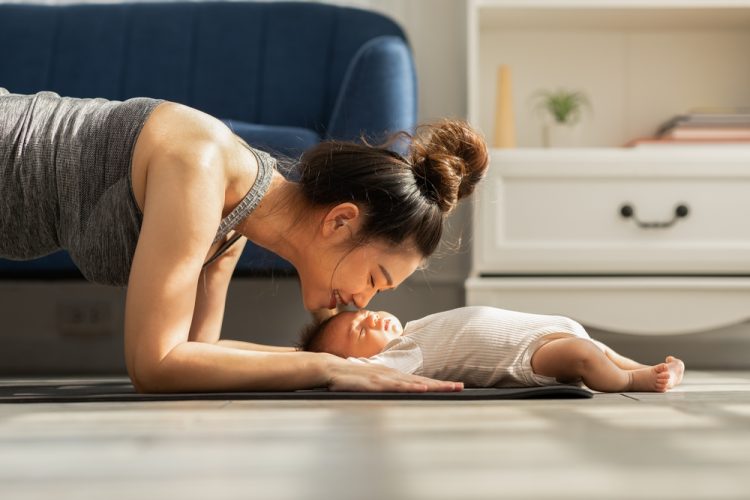
The next layer of activation is coming into a plank position. Bring your forearms to the ground, elbows under shoulders, and with your toes turned under, make a long line with your body. You can also keep your knees on the ground for this one. Keep your hips as high as your shoulders and focus on lifting your belly button toward your spine. Continue to breathe and use the exhale to engage as much of your center as possible.
Think of your core as the stabilizing force that allows the rest of your body to do all the things you want to do. You can activate your center with any kind of movement you are doing, from carrying your keiki, climbing the stairs, or getting up and down from your desk chair (which hopefully you are doing multiple times during the day).
Remember that your core includes your abdominal muscles, your back, your hips, and your upper body. All of these parts need to work as a coordinated whole to keep you strong and injury-free.